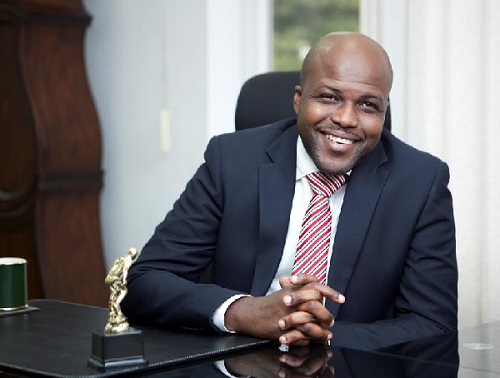
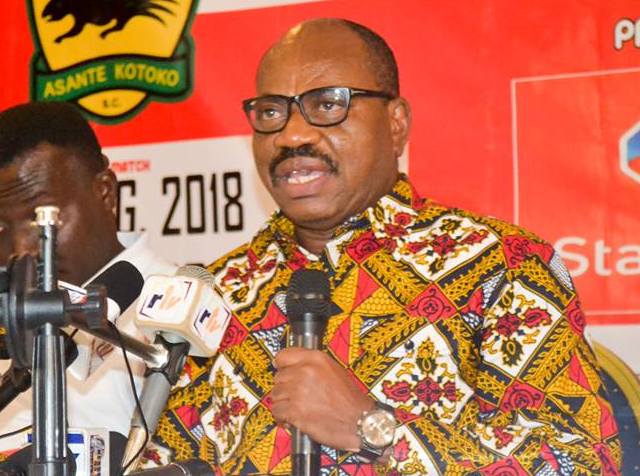
Chief Executive Officer of Databank Group, Kojo Addae-Mensah has mentioned that Asante Kotoko owner should do away with the old format of appointing Board of Directors to steer affairs of the club and hand it to a Sports inclined Company to run.
The Life Patron of the Porcupine Warriors in May, 28, 2020 announced a nine-member board of directors in a bid to fulfill the Club Licensing requirements. He later added three persons to the already inaugurated board to increase their number to 12.
Sharing his opinion on how the Reds could discover their glory days, the Finance expert explained that he does not believe the current structure of the club in the way to go since football has now changed.
According to him, Kotoko had suffered under this same system since the era of Herbert Mensah in 1999, and therefore, should be abolished.
“If Kotoko wants to be successful, I think His Majesty Otumfour Osei Tutu II should look for company like Fenway Sports Group (FSG) of Liverpool and Feyenoord’s partnership with WAFA whose main activities are sports so that they can run the club than forming individual board always,” he told Kumasi-based Ashh FM.
“The challenge is we don’t look for people who understands the rules of the game very well checking from the newly constituted board, only Mrs. Evelyn Nsiah Asare who happens to be in the game the rest are all from other field.”
The Ghanaian giants are in search of a new Chief Executive Officer.
Phar Rangers Bankroller Nana Yaw Amponsah is reported to be in a good position to get the vacant position.
Ghana Premier League side Ashanti Gold are close to landing French tactician Bruno Ferry as the new Technical Director for their Academy.
According to Kumasi-based Oyerepa FM, the Miners are in talks with the former Paris FC shot-stopper to take up the post of the Academy Director.
The Obuasi-based club aims to restart the one-time best Academy in the West African country when the novel COVID-19 pandemic situation calms down hence the decision to appoint the experienced French tactician.
The 57-year-old UEFA Pro License coach is currently unattached after his stay with Ghana’s Division One League side Accra Lions came to a close December last year. He spent close to four seasons with the capital based team.
During his days at Accra Lions, the club nurtured numerous talents including AS Trencin attacker Osman Bukari who featured for the Ghana U23 during the 2020 Africa U23 Cup of Nations qualifiers.
Ferry previously worked at French clubs EF Bastia, Louhans-Cuiseaux FC and AS Dakar Sacré Coeur of Senegal.
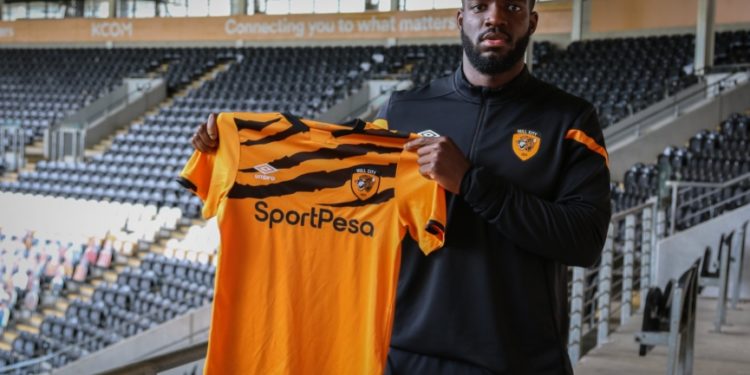
Hull City have captured German-born Ghanaian defender Festus Arthur from Stockport County.
The 20-year-old joins Tigers from the non-league side at an undisclosed fee in a three-year contract with the option of a further year.
Arthur – who can also play as a defensive midfielder has featured in several games for the National League outfit Stockport this season, scoring twice and helping to keep seven clean sheets in 31 appearances.
“I’m very happy to be a Hull City player. It’s something that’s been going on for a while now and I’m just excited to finally join the club,” Arthur told the club’s website.
“I’ve had a good chat with the gaffer and I like him as a person. I’m looking forward to working with him and getting to know my new team-mates. I just can’t wait to get going.”
Arthur has been a long target for Grant McCann throughout 2020. At the end of January, McCann admitted that he was interested in signing Arthur.
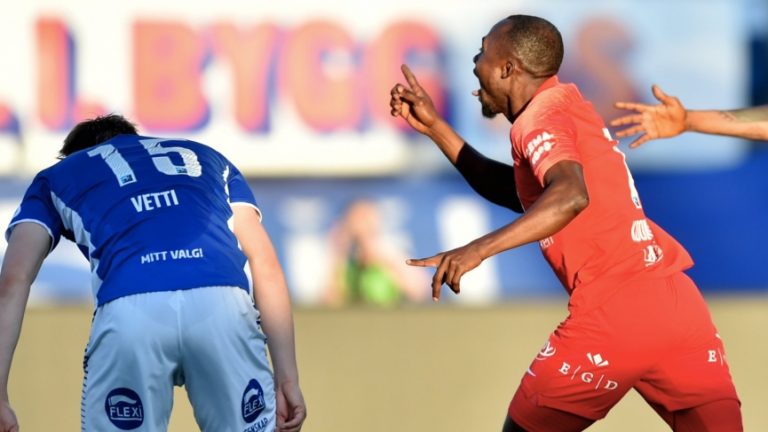
Ghanaian winger Gilbert Koomson scored once again to power SK Brann to a slim 1-0 victory against Sarpsborg 08 in the Norwegian top-flight league Thursday.
Koomson netted the only goal in the evening for SK Brann in an away encounter on match-day five at the Sarpsborg Stadion.
The 25-year-old snatched the only goal for the Red and Black in the 42nd minute of the game.
He could not see full throttle as he paved way for Gilli Rolantsson on the 82nd minute.
Koomson has scored three goals in his five league appearances for SK Brann in the 2020/21 Norwegian top-flight.
He was handed a call-up into the senior national team of Ghana in 2017.
Ghanaians celebrate failure more achievements – Asamoah Gyan
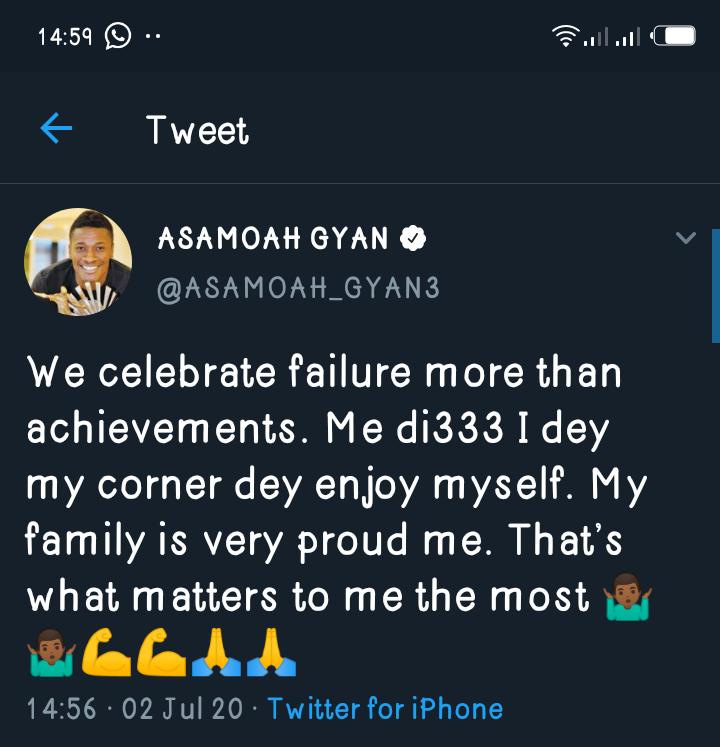
Black stars General Captain Asamoah Gyan has caused a stir on social media with some tweets accusing Ghanaians of highlighting his failures more than what he has achieved since his debut in 2003.
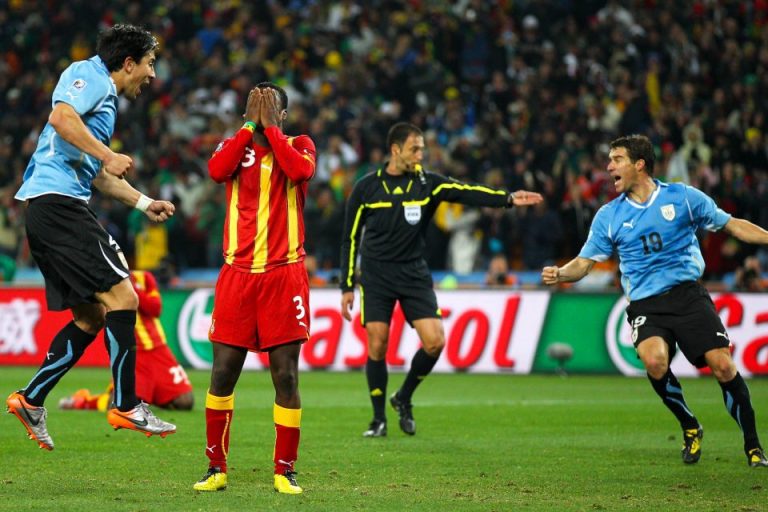
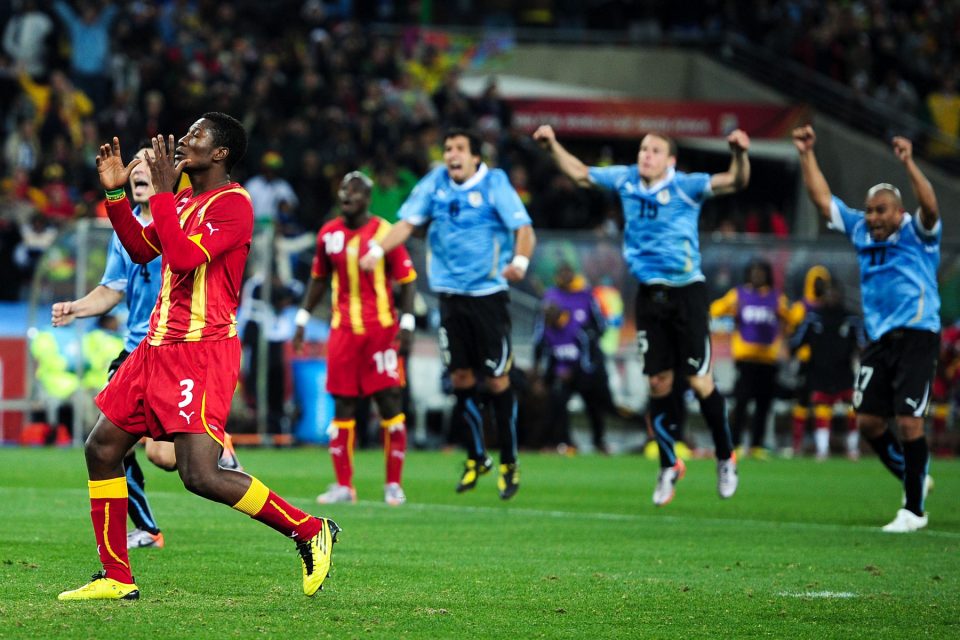
It would be recalled that today is exactly 10 years Gyan failed to score from the spot against Uruguay in the 2010 World Cup.
A victory on that day will have taken Ghana to Africa’s first semi-finals in a World Cup. The images of the infamous miss still haunts some football fans, who took to the social media today to relive.
Responding to some of the comments which seemed unpleasant to the former Sunderland striker, Gyan tweeted that ‘Ghanaians celebrate failure more than entertainments.
“We celebrate failure more than achievements. Me di333 I dey my corner dey enjoy myself. My family is very proud me. That’s what matters to me the most”
Gyan is the all-time leading goalscorer of the Black Stars with 51 goals in 109 appearances.
He is currently unattached after he was released by Indian Super League side NorthEast United in January.
Outspoken Joseph Emmanuel Sarpong has implored Ghanaian football clubs to demand for compensation from the Ghana Football Association for truncating the 2019-20 football season.
The Ghana FA Executive Council on Tuesday, June 30 2020 annulled the 2019/20 football season on health grounds after all attempts to ensure the resumption of football in the West African country proved futile.
The veteran tactician lambasted the Ghana FA for failing to work their way through for football to return.
“They didn’t put in enough effort to get the league restarted and failed enough to ensure that the league bounces back” he told Akoma FM.
“Clubs must make a case for compensation for all the wasted effort and resources caused by the cancellation of the league” he concluded.
Meanwhile, world governing body, FIFA will dole out $1.5 million to member associations as it tries to lessen the financial constraints of the federations due to the COVID-19 pandemic.
Erstwhile Chief Executive Officer of Asante Kotoko, George Amoako has divulged that he is done with the club with regards to taking up any official position in the club.
The Ghana FA Executive Council member was sacked by the former Executive Chairman Dr. Kwame Kyei last month after a nine-member board was inaugurated.
Amoako has had several different spells at the Ghana Premier League record holders in the last three decades.
The astute football administrator has ruled out any possible return to the Porcupine Warriors although he still supports the club.
“Enough is enough now for me with Kotoko. I will not return to the club in any official position even though I’m still a Kotoko faithful.” Amoako told Kumasi based radio FOX FM
“It is true that Kotoko owes me salaries for five months. But I have not written officially to demand it as speculated by some media” he added
Amoako has been linked to Ghana Premier League side King Faisal as their new Chief Executive Officer.
Reports indicate that Dreams FC as well as another unnamed club are also interested in securing George Amoako as CEO.
Ghana Premier League side Dreams FC have shown interest in securing the services of astute football administrator George Amoako as Chief Executive Officer of the club.
The experienced football administrator was recently sacked by the Porcupine Warriors after the new board of directors decided to recruit a new management team.
According to Kumasi-based Oyerepa FM, Dreams FC is interested in George Amoako becoming CEO of the club with another club also interested, making it 3 clubs.
King Faisal, through the Bankroller, Alhaji Karim Grusah revealed having negotiations with Amoako – which the Ghana Football Association Executive Council member has confirmed.
George Amoako worked with Herbert Mensah at King Faisal FC in 2003.
Astute football administrator, George Amoakoh has confirmed that he is on the verge of joining Ghana Premier League side King Faisal FC.
The Bankroller of the Kumasi-based club Alhaji Karim Grusah revealed Wednesday that talks are far advanced in appointing the former Asante Kotoko Chief Executive Officer to steer affairs of the Isha Allah Boys.
The Ghana Football Association Executive Council member was sacked by the Asante Kotoko after a new board was constituted.
Speaking to Kumasi-based Oyerepa FM, Amoakoh disclosed he will be glad to work with another Ashanti team although talks are yet to be concluded.
“Yes it’s true there are negotiations ongoing but not concluded yet. I will love to join another Ashanti Team,don’t forget i have been there before and it looks like am tilted towards there but we are yet to firm it. George Amoako explained to Oyerepa FM.
George Amoakoh worked with King Faisal in 2003 during the era of Herbert Mensah.
It is quite difficult, especially for Ghanains, to come to a conclusion on how Ghana should be remembered for their performance in the 2010 Fifa World Cup.
There was the quality football, the march to the quarterfinals that drew remarkable support from the rest of the continent and the making of reputations. But there was also the sense of failure, the feeling that once again when presented with the chance to reach the last four of the World Cup for the first time, an African team blew the opportunity.
Ghana’s journey in 2010 is a story every African football fan is familiar with. As the only team from the continent left standing in South Africa, the Black Stars were within one penalty kick of becoming the first country from the continent to reach the semifinals of the tournament after Cameroon (1990) and Senegal (2002) couldn’t break the quarterfinals ceiling.
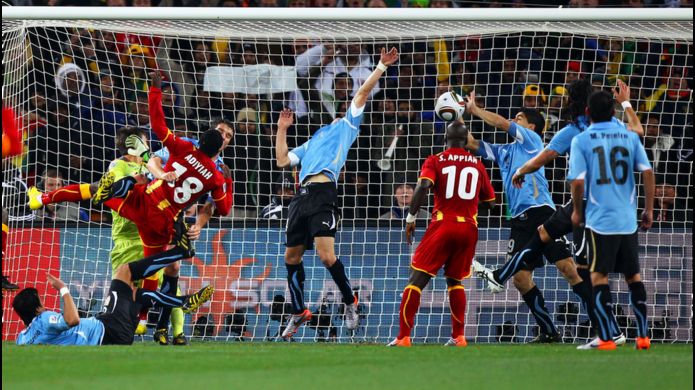
After taking the lead through Sulley Muntari just before halftime, the Black Stars lost it to a Diego Forlan stunner. Then the game just drifted away till the final minutes of extra time. A Ghana free kick caused chaos in the Uruguay box, Dominic Adiyiah headed what looked like a goal-bound effort but Luis Suarez was on the line and stopped it with his hand.
Penalty for Ghana. Red card for Suarez. Delight for the crowd. Up stepped Asamoah Gyan whose penalties had secured the four points, against Serbia and Australia, that took Ghana to the knockout stage. There was no way he was going to miss it, right? He did, striking the ball against the crossbar to take the match to the penalty shootout that Ghana lost.
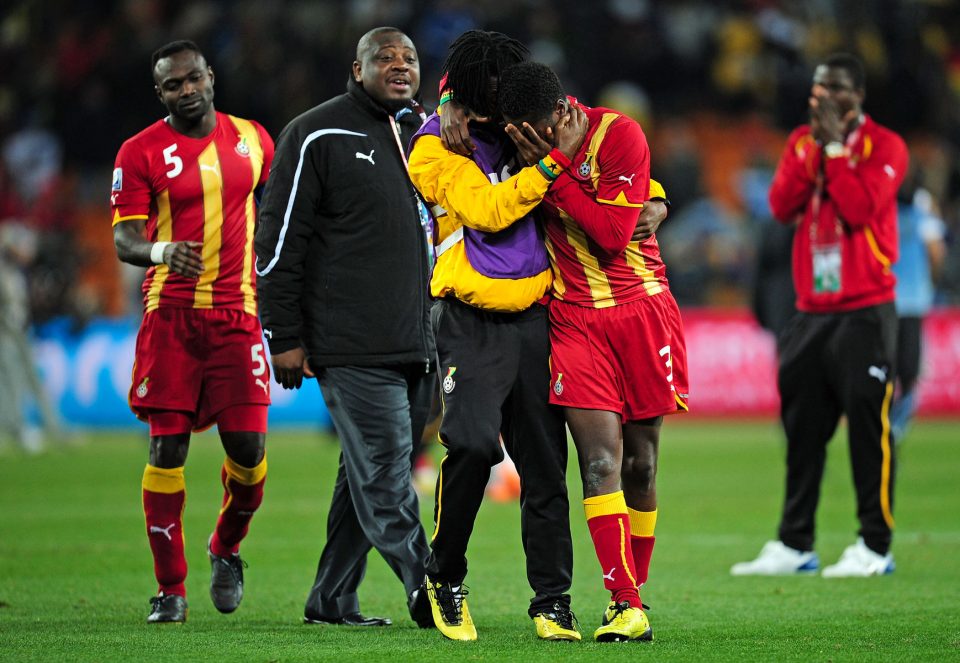
In Ghana, everyone remembers where they were when they were overcome by the sheer shock of seeing Gyan miss that penalty. The team was traumatised, moving from joy to dejection. Instead of victory laps, they broke down in tears on the field after the final whistle. Those tears continued to the dressing room and the players emerged into the mixed zone looking painfully sad.
“There were a lot of tears, I won’t lie. We hardly said a word to each other there,” rightback John Paintsil told New Frame.
The morning after, on 3 July 2010, Gyan told me how relaxed he now was, how mentally strong he was and that life had to go on. Ten years later, that attitude has not changed. “I always go back and watch the penalty,” Gyan says. “I shake my head when I see it. I wish we could go back and have the penalty but life goes on. Many great players have missed penalty kicks but life goes on. It’s something that I would never forget.”
2 July 2010: Asamoah Gyan of Ghana reacts as his penalty kick ricochets off the crossbar and into the Soccer City stands in the last minute of extra time. Ghana went on to lose to Uruguay on penalties. (Photograph by Clive Mason/ Getty Images)
How 2010 changed Gyan’s life
Gyan refuses to let the pain of the missed penalty cloud what he considers the bigger picture. And for him that is two-fold. First is that South Africa put on a stunning party and shamed the critics and second how the competition and that year generally changed him.
“For me, 2010 was the most exciting World Cup I have seen,” says Gyan, who has played and scored in three World Cups: in Germany (2006), South Africa (2010) and Brazil (2014). “It was unique. We saw the fans from everywhere, the emotions, the pride of the continent, the food and everything. It was amazing.”
On a personal level, Gyan truly announced himself to the world, earning a breakthrough move to the English Premier League side Sunderland after spells in Italy and France. His international career was also beginning to pick up. He arrived at the World Cup having scored three goals to take Ghana to a first Africa Cup of Nations (Afcon) final in almost 20 years. He was slowly redeeming himself from a miserable 2008 Afcon where he was so heavily criticised that he threatened to leave the team camp.
“2010 changed my life. It was the best year of my career. Music, business, contracts, winning awards. I became an icon for people. I was on top of the world and living the life I could never forget,” Gyan said. “It started from the club side. I was in top shape, physically. Mentally, no injuries. Obviously this World Cup made me a household name and famous in the world.”
For all the claims by Gyan that “we were obviously in the form of our lives,” the Black Stars for much of the tournament walked a tightrope. In the opening game against Serbia, they required a late Asamoah Gyan penalty to win. Then against Australia, Gyan scored from the spot again in a 1-1 draw. Defeat to Germany in the final group game meant a few nervous minutes before the Black Stars learnt they had qualified for the quarterfinals. Then it took a Gyan stunner in extra time against the United States to send the Black Stars through to the quarterfinals, becoming the only African country to make it out of the group stages.
Stephen Appiah, who captained Ghana in the 2006 World Cup and played in 2010, calls the side that came to South Africa the best Ghana squad that he has been part of because “we had so much quality on the bench. You took a player out and it was as if nothing had happened”.
2 July 2010: Ghana’s technical team and players console Asamoah Gyan after he missed a potentially match-winning penalty in their quarterfinal defeat to Uruguay in the 2010 World Cup. (Photograph by Clive Mason/ Getty Images)
Backed by the continent
Gyan remembers the immense support Ghana got from the continent and feels the team really blew a big opportunity to make history. “We were that confident. We were doing the right things on the field and it looked like we were even going to win the World Cup. That’s how confident I was.”
One of the consolations for Gyan the morning after the Uruguay defeat was to claim that “this team is young and in 2014 we would do better.” It didn’t happen. In 2014 Ghana did worse, turning their World Cup campaign into a bitter and disastrous experience plagued by money issues and in-fighting.
For many people, that is just the problem. Ghana and many African countries seem unable to build on previous World Cup strides. Cameroon have not made it out of the group stage 30 years after they became the first African country to reach the last eight of the tournament. After their remarkable run in 2002, Senegal did not reach another World Cup until two years ago.
It has been a similar story for Ghana. The disappointment and shame of Brazil 2014 was followed by failure to reach the 2018 World Cup. Aslo, in that time, the country has not won the Africa Cup of Nations. And careers that were expected to blossom off the back of that competition have drifted away.
Asamoah Gyan was a one-season hit in England before he went to play in the United Arab Emirates where he scored more than 100 goals in his two stints. Dominic Adiyiah went from within a fraction of scoring a goal to take Ghana into a World Cup semifinal to a journeyman. He now plays his football in Thailand. Samuel Inkoom has struggled too, as has Isaac Vorsah.
Despite this fall from grace, there is no doubt that in 2010 Ghana stepped up in style. The streets of Pretoria sometimes felt like Oxford Street in Accra’s Osu and the players responded on the field. No wonder the day after the Uruguay game, amid the tears and bitter disappointment, the players drove through Soweto to complete adulation. They also met Nelson Mandela in what Gyan called the ultimate congratulatory gesture towards them. They then returned to Accra to a proud and big welcome.
None of us would forget South Africa 2010 in a hurry because it reminded us of Ghana’s immense football abilities, even though it also exposed its innate weakness in the sport too.