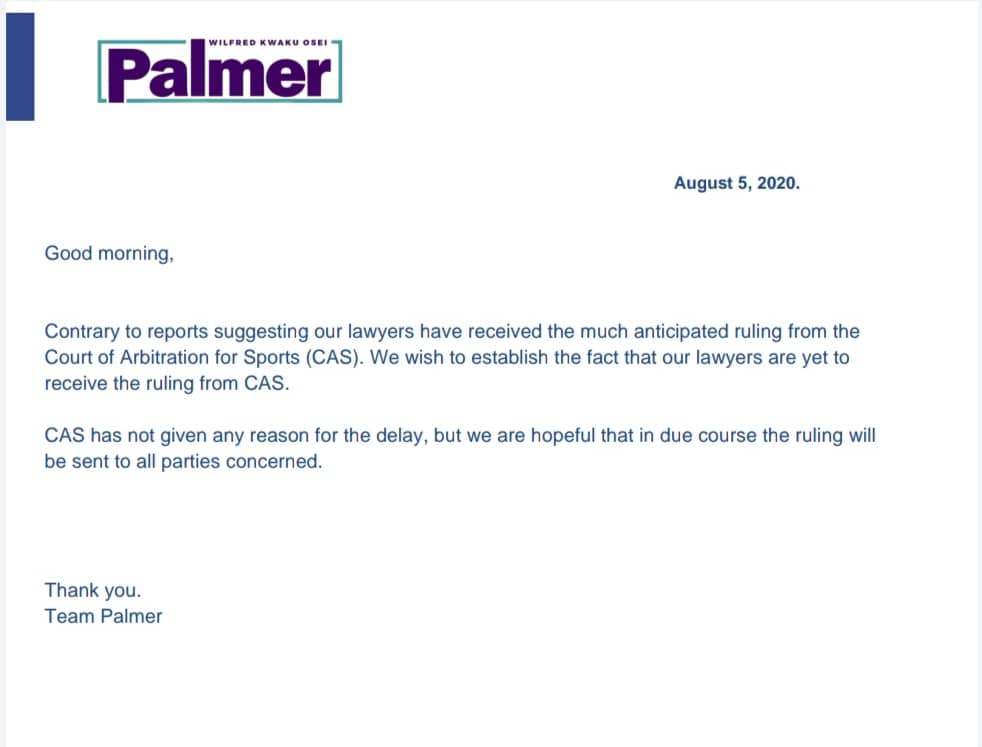
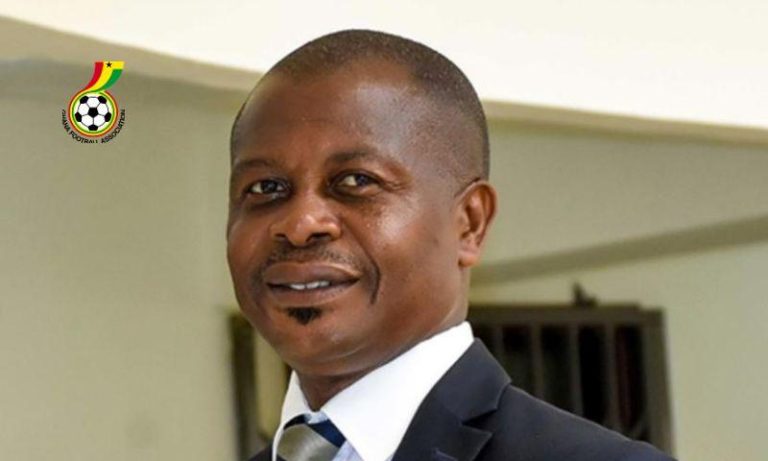
The astute football administrator has shrugged off reports in the media that he has received a verdict from the Court of Arbitration for Sports.
Founder and Bankroller of Tema Youth FC, Wilfred Kwaku Osei Palmer has distanced himself from the reports in the local media.
Osei Palmer decided to drag the Ghana Football Association to the Court of Arbitration for Sports following his disqualification from the 2019 Ghana Football Association elections.
The Court Arbitration for Sports postponed the day for the much-anticipated ruling to 4th of August.
However, the Ghana football fraternity was swerved by the Swiss-based court over the verdict of the above-mentioned case on August 4.
The former Ghana U20 management committee chairman issued a press statement on Wednesday morning to debunked such reports purported by some media outfits.
There is massive tension in the air after the Court of Arbitration for Sport (CAS) failed to deliver the much-anticipated verdict involving Wilfred Kweku Osei “Palmer” and the Ghana Football Association on Tuesday.
The delayed verdict has sparked an uneasy calm for both the appellant and defendant.
Palmer is seeking to overturn last years Ghana FA Presidential election after being disqualified. The global tribunal body confirmed Tuesday, August 4 as the date to announce the verdict to bring to an end 10-month litigation which has far-reaching implication for the administration of football in the West African nation.
While several watchers had been keen on the much-awaited verdict, CAS swerved Ghanaians by refusing to release the final judgment on Tuesday after an initial postponement from July 17.
These are frenetic times for the followers of both disqualified Osei and current FA boss Kurt Okraku.
Palmer dragged the FA to the apex of world sports court after he was disqualified from contesting the 2019 Presidential election by the Normalisation Committee.
There are two things likely to happen – CAS to throw out the case and allow the status quo to remain or order for a re-run of the election if it was deemed the plaintiff was unfairly disqualified from the race. CAS will announce the decision whether to uphold Palmer’s quest to annul the election and order for fresh polls to decide on a new President for the GFA or allow the status quo to remain.
The situation has put the presidency of Kurt Okraku on the line with wide-reaching implications if Palmer becomes successful.
The ruling from CAS will put to rest months of intense anxiety involving all the principal actors.
An initial ruling on July 17, 2020, was postponed to Tuesday, August 4, 2020.
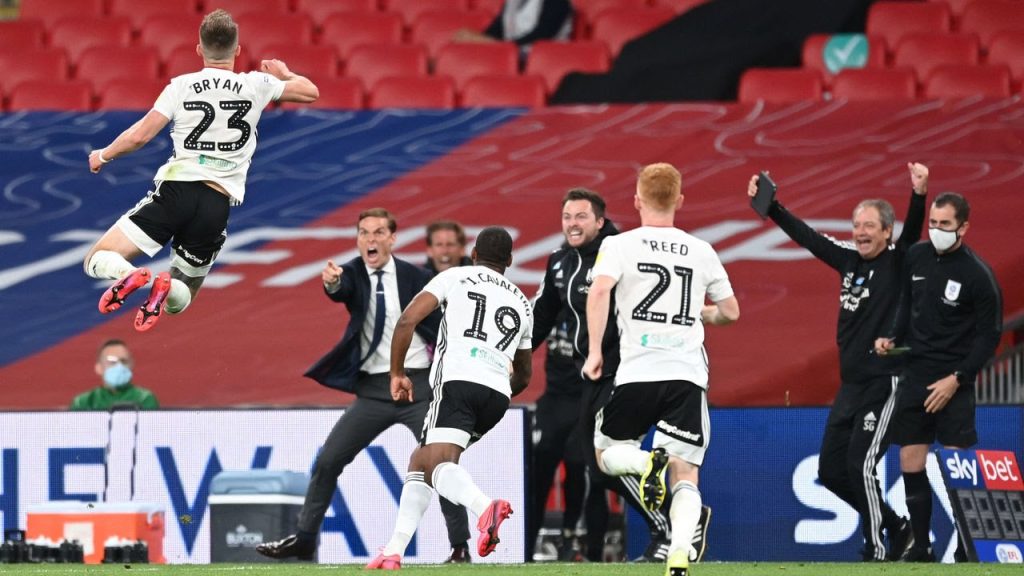
Fulham earned promotion to the Premier League on Tuesday thanks to an outrageous free-kick and composed finish by Joe Bryanduring extra time of a nervy playoff final with Brentford.
A quick set-piece in the 105th minute by the Cottagers’ left-back caught out Brentford goalkeeper David Raya from at least 40 yards before Bryan – who last scored in September – made it 2-0 following a tidy one-two with Aleksandar Mitrovic.
Henrik Dalsgaard grabbed a late goal for Brentford but there was no time to overcome the first double of Bryan’s professional career. Fulham had booked an instant return to the top flight following their disastrous relegation in the 2018-19 season.
“I’m not the hero, every single one of them, fans and people around us who has been with us all season is,” Bryan told Sky Sports after the final whistle.
“We’ve been written off five, six, seven, eight, nine, 10 times, I think I read somewhere we were supposed to be scared of them.”
Fulham, as is often the case, had the most possession in the opening period while Brentford lacked the usual zip in their play. There were few genuine chances for either side, with the biggest talking point provided by Harrison Reed‘s yellow card for a committed challenge on Christian Norgaard. If there were fans in the stands, the ones backing Brentford would’ve been calling for Reed’s dismissal – and with some justification.
The nerves that regularly stifle Championship playoff finals were evident in the second half as well. Increasing pressure from Brentford may have prompted Scott Parker’s first Fulham change when he brought on Anthony Knockaertin the 81st minute. Aleksandar Mitrovic, the Championship’s top scorer who missed the semifinals through injury, seemed to warm up for an eternity before he was introduced minutes before the match entered extra time.
The game opened up and errors became likelier as the players tired in the additional 30 minutes. Tempers also began to fray, with Mitrovic pushing Emiliano Marcondes down by the throat during a set-piece. There is no doubt that the Serbian striker would’ve been dismissed if there was video review.
But, after referee Martin Atkinson calmed the players down, Fulham scored from the same set-piece. Bryan later said he followed instructions from Parker when he ambitiously aimed for the near post, and the execution was perfect as it caught out Raya. The Brentford shot-stopper was anticipating a lofted ball toward the huddle of players in front of him rather than an effort on his mesh.
Bryan’s second goal occurred while Brentford were piling bodies forward for an equalizer. The defender angled a run into the center, exchanged passes with Mitrovic, and executed a slick finish into the bottom corner.
There was barely time for kickoff after Dalsgaard converted his 124th-minute header.
“I can’t put it into words. It feels special. We got written off a bit this year, no one talked about us, they talked about Brentford and Leeds,” Fulham captain Tom Cairney shared with Sky Sports. “It shows the spirit in the dressing room, not many teams bounce back up.”
With the win, Fulham joined Leeds United and West Bromwich Albion as the three clubs to clinch promotion to the Premier League in 2019-20.
Brentford narrowly missed out on automatic promotion during the regular Championship season, but they will now enter their 74th year without top-flight football.
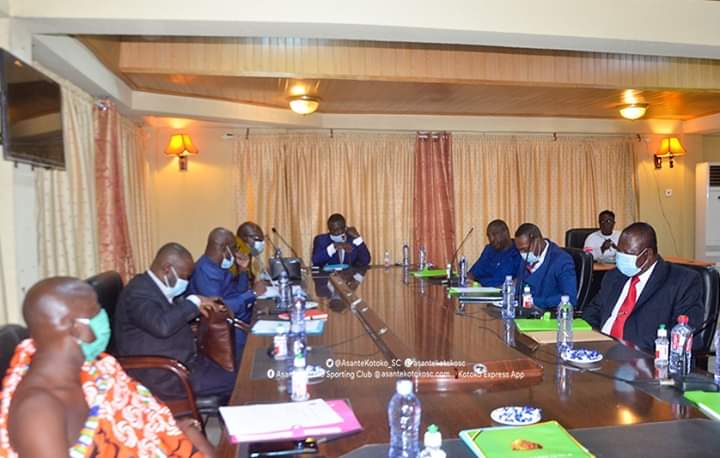
Asante Kotoko Board of Directors have finally settled after their marathon meeting on Tuesday to officially unveil new Chief Executive Officer for the Ghanaian giants on Friday, August 7, 2020 at Sports hotel.
The Board of Directors in consultation with the Asantehene and Owner of the Club, His Majesty, Otumfuo Osei Tutu II, have resolved to confirm former Ghana Football Association Presidential candidate, Nana Yaw Amponsah as the new head of management.
The sophisticated football administrator holds a Bachelor of Arts Degree in Psychology and Political Science from the University of Ghana, Legon, and a Master’s Degree in Sports Law and Practice from the Leicester DE Monort University, UK.
The owner of Division One side Phar Rangers has also been given the opportunity to pursue a PhD in Sports Leadership at the Concordia University in United States of America (USA). From 2008 to 2018, he was a Licensed Player Agent/Intermediary and transferred over 50 players from Ghana and almost 100 across the globe, which brought huge revenues to Ghanaian Clubs in the process.
The Prestigious 40 Under 40 awardee, is touted as one of the best brains to push the two times CAF Champions League winners to its best status.
Asante Kotoko has been without a substantive Chief Executive Officer after the erstwhile Management led by George Amoako.
The Club is being run on daily basis by an interim Management led by Board Member, Joseph Yaw Adu.
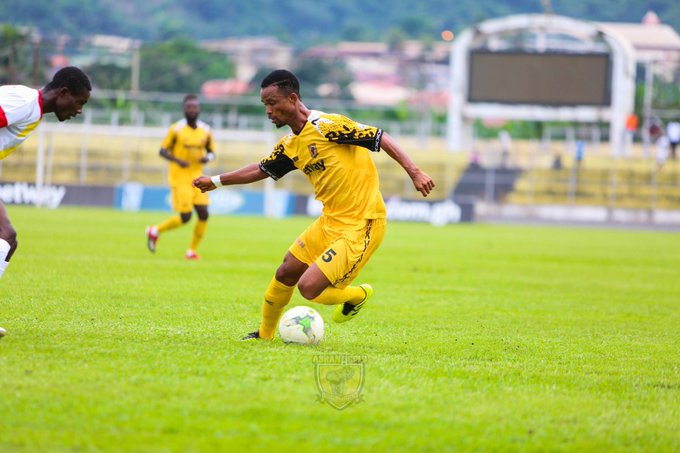
He was the Rainbow Boys’ stand-out player in the truncated 2019/20 Ghana Premier League.
Speaking to Accra-based Angel TV, Afutu disclosed that he is in contract renewable negotiations with his club.
“I signed 4 years for Hearts, I have played 3 years and I am left with 1year I am in a contract renewal negotiations with Hearts of Oak, ” he told Angel TV.
According to footy.ghpush.com/ sources, Afutu will pen down a new two-year deal with Hearts Of Oak.
Midfield sensation Maccarthy Appiah has renewed his contract for two years.
The player who joined from Asokwa Deportivo in the 2016/2017 season has spent 4 seasons with the club. This new agreement will see him spend two more years in the club, until July 2022.
The 24-year-old played a total of nine (9) games in the truncated 2019/2020 league season, after recovering from an injury which kept him on the sidelines for close to two months.
This comes as a major boost for the team as part of preparations towards the 2020/2021 season.
After his initial 3-year contract with the Miners ended last month, experienced center back Richard Osei Agyemang has renewed his contract with Ashantigold for three years. This new agreement will see him with the club until August 2023.
The 25-year-old defender featured in 5 games in the truncated 2019/2020 league season, after suffering from an injury which intermittently kept him on the sidelines.
Upon renewing his contract, the player expressed his excitement and reiterated his commitment to the club:
“After spending three seasons with the club, I am really excited to renew my contract. I am having great expectations. I am excited to accept this offer to stay at Ashantigold so that I can contribute to the success of the club.”
Agyemang, who has now recovered from his injury anticipates a successful stay at the club, as he awaits the resumption of football activities in Ghana.
This comes as a major boost for the team as part of preparations towards the 2020/2021 season.
The 2019 Ghana Football Association Presidential candidate has landed the top position at the Porcupine Warriors, according to Opemsuo FM.
Founder and Bankroller of Division One League side Phar Rangers, Nana Yaw Amponsah has been appointed the new Chief Executive Officer of Ghanaian giants Asante Kotoko SC.
The brainy football administrator was picked ahead of former Bayern Munich defender Samuel Osei Kuffour after a meeting held between the Manhyia Palace and the newly constituted twelve-member board of directors of the club.
The board of directors settled on Nana Yaw Amponsah for the vacant position after George Amoako led management team was dissolved months ago.
According to Manhyia based radio station Opemsuo FM, Nana Yaw Amponsah has been appointed as the new Chief Executive Officer after a meeting held on Monday. The official announcement of the young football administrator as the new CEO of the two-time CAF Champions League winners this week.
Ampomah wowed the 12-member Asante Kotoko board after presenting a 33-page document to be implemented over a five-year period last month. He was once a FIFA intermediary and secured a deal with Turkish kit manufacturing company Fitcom to provide apparels to some Ghana Premier League and Division One League clubs.
Ampomah has a good relationship with Championship side Queens Park Rangers and was reportedly to land a top position at the English club.
The Court of Arbitration for Sport has deferred giving verdict in the case of Wilfred Kwaku Osei v the GFA to next month. We recall the background to the dispute and consider how it may play out.
On 4 October 2019 the Ghana Football Association (“the GFA”) Normalisation Committee (“NC”) announced that Amanda Clinton, George Ankoma Mensah, Nana Yaw Amponsah, Kurt Edwin Simeon Okraku, George Afriyie and Frederick Pappoe had completed the vetting process for the then pending GFA elections.
Osei Kweku Palmer
According to the NC, although Wilfred Kwaku Osei (“Palmer”) applied to run for the office of GFA president, his application was unsuccessful. He appealed the decision three days later but this, too, was dismissed.
On 9 October, Palmer responded in a letter:
“I duly filed my appeal on Monday at 3.40 pm, I further filed an interim injunction and requested for a record of proceedings which was handed over to me after 5pm on Monday 7th October 2019 on pen drive. As I earlier indicated in my statement on Tuesday 8th October 2019, I filed an appeal on Monday 7th October 2019. However, there is an erroneous impression created by the Normalisation Committee and its assigns that I failed to file an Appeal. For the avoidance of doubt, my appeal brief indicated all the issues I was seeking for.”- Advertisement –
Subsequently, Palmer took the matter to the Court of Arbitration for Sport (“the CAS”), claiming that he was “unfairly disqualified”.
Why did the NC disqualify Palmer in the first place? My understanding of the letter from the GFA to Palmer in 2019 is that his application failed because of the GFA Ethics Committee’s decision of January 2017, and because of a violation of Article 35(c) of the GFA statutes.
What was the legal basis for Palmer’s disqualification in the light of the alleged existence of: (1) the GFA Ethics Committee decision of January 2018, and (2) a violation of Article 35(c) of the GFA statutes?
Months before the 2019 GFA elections, FIFA introduced an integrity test after the expiration of the NC’s term. From what I have gathered, the integrity test is a test conducted during the vetting of candidates for football-related offices which gauge a candidate’s reputation for being truthful and honest. It begins with a self-disclosure component, which elicits answers to questions.
The questions mostly pertain to the candidate, including whether or not they have ever been found culpable and/or sanctioned for conduct which violates “the general conduct rules” of the FIFA Code of Ethics, and whether or not a candidate is currently in compliance with all applicable laws.
What details, as alleged by the GFA, formed the basis for his disqualification?
In an interview with Citi FM, offering a post-mortem of the Black Stars’ failure to qualify for the World Cup in 2017, Palmer made a number of comments which were rather shocking, not so much because of what he said, but the fact that he could say it publicly.
“If we had spent around $300,000 [on referees] and stood to benefit about $8 million [by appearing at the World Cup], I see nothing wrong with it.”
He was hauled before the Ethics Committee for a hearing. The committee reprimanded Palmer for the statements and ordered him to apologise on 8 January 2018, in line with Article 13 (28) of the GFA Ethics Code. He was also advised to refrain from making further public statements relating to the GFA.
Palmer obliged, wrote and filed an apology letter to the GFA Ethics Committee and did as instructed, refraining from making public statements related to the Association.
Before we go any further, let’s go back to 2018, shall we? In June that year, Tema Youth transferred Joseph Paintsil to the Belgian side Koninklijk Racing Club Genk in a deal worth €3 million.
Under normal circumstances, Tema Youth would have paid 10% of the transfer fee to the GFA, which would then issue an international transfer certificate (ITC) for the deal to be processed, as required by the regulations. That did not happen.
Tema Youth say they requested an ITC from the GFA but one was never granted. Instead, FIFA had to issue a provisional ITC for the deal to go through. This, Tema Youth say, strengthens their belief that the GFA has lost its entitlement, because it played no part in the transfer process.
Conversely, the GFA believes Palmer acted in bad faith because he had earlier signed an agreement with them to pay €300,000 to the GFA subject to the issuing of the ITC.- Advertisement –
A few months to the elections, the NC’s lawyer, Frank Davies, wrote to Palmer and Tema Youth, asking them to pay the money. Palmer refused.
My understanding and the findings of my research are that the GFA appears to allege that Palmer, in his capacity as a football official as defined by the GFA and FIFA Ethics Code/s, due to his position and direct involvement as an official and de facto managing director and controller of his club, Tema Youth Sporting Club, failed to ensure that his club honoured its financial obligations to the GFA. It is the GFA’s view that because the club failed to pay to the required 10% of a foreign transfer into the GFA development fund, Palmer and Tema Youth have violated Article 35(c) of the GFA Statutes.
Consequently, the GFA appears to contend that the statements are prima facie violations of Article 13 of the FIFA Ethics Code. It is my understanding that the GFA also considers the failure to pay the 10% into the GFA development fund constitutes conduct that is a prima facie violation of Articles 13(1), (2), (3) and (4) of the FIFA Code of Ethics, as well as Articles 29(1) and (2). If this is established to be true, it would create a conflict of interest that would violate Article 15 of the FIFA Code of Ethics if Palmer were elected as GFA president – all of which should have been listed on the integrity test questionnaire. Wawolo!
Palmer’s arguments Palmer’s claim of unfair disqualification appears to be based on his position that his disqualification was pretextual and based on his refusal to pay the 10% of the funds received from a foreign transfer to the GFA developmental fund.
Palmer also contends that his club was not under the obligation to pay the 10% it received as payment for Joseph Paintsil’s transfer from the club to KSR Genk, to the GFA development fund. Why? Because the GFA did not issue the international transfer certificate for the player.
My sources tell me that Palmer also contends he has already been punished for the statements he made on public radio in 2017 and that some of the Vetting Committee may not have held other candidates to the same strict standards.
The CAS considerations I believe, from my research and understanding, that the Court of Arbitration for Sport (CAS) will only review a decision of an Elections Committee on a FIFA-related election, if the Elections Committee in question could not reasonably have decided to exclude a candidate.
In determining whether or not the Elections Committee had reached its decision to disqualify a candidate reasonably, CAS appears to look at the basis on which the decision was taken. That is to say, CAS will seek to be convinced that the basis is grounded on evidence of a specific course of conduct by the candidate available in a candidate’s file at the time of the evaluation, which is a prima facie violation of any of the general conduct rules of the FIFA Code of Ethics.
How do the two cases (Palmer and GFA) compare?
Although Palmer apologised for his conduct concerning public statements about Ghana’s failure to qualify for the 2018 FIFA World Cup, the GFA’s position – that the apology in itself does not vitiate the existence and/or evidence of his conduct – may prove difficult to dispel.
It is tempting to argue that Article 35(c) of the GFA Statutes is unambiguous as to the conditions under which the payment of the 10% of proceeds of international transfer must be paid into the GFA development fund. By existing convention, it is always due when a GFA-affiliated club receives payment for the international transfer of any of its players. However, you cannot disregard Palmer’s position, either – at least not entirely.
His interpretation of Article 35(c) is that the GFA’s inability to issue the International Transfer Certificate (ITC) strengthens his belief that the GFA loses its entitlement, as it played no part in the transfer process. Conversely, the GFA believes Palmer acted in bad faith because he had earlier signed an agreement, in his capacity as an official of his club with the GFA, to pay €300,000 to the GFA after the ITC was issued.
How will this be interpreted by CAS? I have no idea but that is their job.
Now, if there is evidence that the Elections Committee said that it will disqualify Palmer for not paying the said amount into the GFA development fund as promised, Palmer still has to prove that the GFA Elections Committee decision to disqualify him was not supported by evidence and that it could not have reasonably concluded so.
Even if there are similarly situated candidates who were not disqualified it will not help Palmer’s case if there is still evidence of his conduct which violates the FIFA Code of Ethics. Similarly, the GFA has to be prepared to convince CAS that this did not happen – because, if anything is certain, it is that Palmer’s legal team will clutch at anything to prove its case, as a drowning man will to a straw.
All of this makes for a compelling showdown and I, for one, cannot wait for the verdict.
So, with bated breath, we wait, as Palmer and the GFA learn their fate in an undoubtedly seminal ruling. Seminal in the sense that a win for the GFA potentially ends Palmer’s presidential ambitions. Conversely, victory for Palmer could annul last year’s elections, forcing fresh elections.
The Executive Council of the Ghana Football Association (GFA), has appointed Mr. Sampson Narteh-yoe, a Financial Economist to replace Mr. Wilfred Kwaku Osei on the three-man Ad-hoc compensation Committee.
This follows the decision of Mr. Kwaku Osei, President of Tema Youth Sporting Club to decline his appointment to serve on the committee for personal reasons.
Mr. Narteh-yoe is a lecturer in Finance and Business Policy and Strategy with over 20 years work experience in various industries including Telecoms, Banking, Petroleum, FMCG, Manufacturing and NGOs.
Currently, he is a finance consultant and lectures Business Policy and Strategy, Investment and Portfolio Management, International Trade Finance and Project Financing at the University of Professional Studies, Accra.
Mr. Narteh-yoe is expected to bring his experience to bear when he joins Mr. Frederick Nana Kweku Moore, the Chief Executive Officer of Accra Hearts of Oak Sporting Club and Mr. Delali Eric Senaye, Chief Executive Officer of Inter Allies Football Club on the Committee.
The mandate of the Committee, as provided under Article 42(2) of the GFA Statutes 2019, is to propose to the GFA Congress the remuneration of members of the Executive Council.
The Committee is expected to submit its work in time to form part of the Congress documents that will be sent to members of Congress as the formal convocation of Congress under Article 31(3) of the GFA Statutes 2019.